Premise
I want to replicate the study of Lavefjord et al., 2025 with adolescents. Vogel et al., 2025a have developed a semi-standardized interview to assess PECAN with children and adolescents (12-18), but only using symptoms and network model of psychopathology.
The most important difference is the differentiation between symptom and process of change. In the study of Lavefjord et al., 2025, the clients had to assess how certain they were that the node causally affected each of the other nodes with a VAS.
Considering the categories of Vogel et al., 2025b, Lavefjord et al., 2025 used:
- as node property, modifiability
- To what degree do you feel that you would be able to affect…
- your levels of openness?
- your levels of awareness?
- your levels of engagement?
- how difficult it is for you to conduct your desired activities?
- To what degree do you feel that you would be able to affect…
- as edge assessment, certainty:
- 5. Rate how sure you are that lack of openness leads to lack of awareness
-Example: Difficult thoughts or feelings that govern you, in turn distract you in everyday life.
-Example: Difficult thoughts or feelings that govern you, leads to tunnel vision/difficulties getting perspective on things.
- 5. Rate how sure you are that lack of openness leads to lack of awareness
I’ll use as node properties:
- frequency
- severity
- modifiability
- controllability
To assess edges, I’ll use:
- certainty: “Do you think your sadness is caused by talking to your mother?”
- frequency: “How often do you fell sad, when you talked to your mother?”
- counterfactuals: “If you no longer talked to your mother, would you still feel sad?”
- strength: "How strongly does your mother influence your sadness?"
Introduction
Many ACT protocols start with a process of the hexaflex independently of the individual receiving therapy. However, the PBT golden rule says:
What core biopsychosocial processes should be targeted with this client given this goal in this situation, and how can they most efficiently and effectively be changed? (Hofmann & Hayes, 2019)
One way to assess which process should be targeted with an individual in a specific situation could be to assess its centrality. As data‑driven networks based on extensive longitudinal data require many repeated measurements (which is even more difficult with children and adolescents), a good alternative could be the perceived causal network approach, or PECAN.
With this method, we can assess within one session which ACT‑Triflex process is most central and try to test the centrality hypothesis in adolescents. This could help ACT practitioners decide which process they should start with, enabling a more personalized and hopefully more effective therapy.
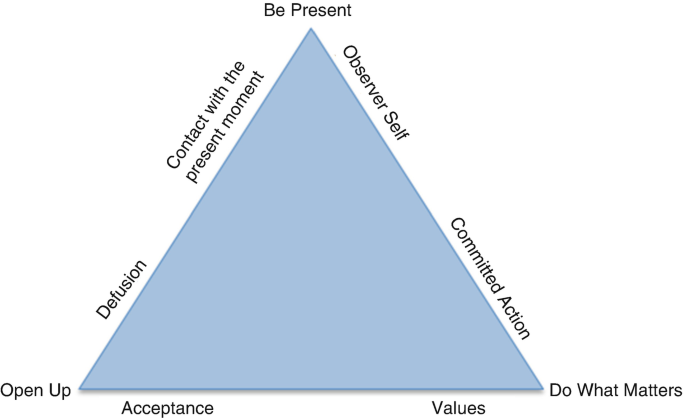
In this study, I will assess PECAN in session 0 with an interview adapted from Vogel et al., 2025a. After the interview, the Most Central Node Intervention (MCNI) and Least Central Node Intervention (LCNI) are identified. In a SCED, individuals are randomized after the baseline phase to receive first MCNI and then LCNI, or vice versa.
Hypotheses:
H1: Individuals receiving MCNI before LCNI will show outcome improvements during MCNI and no additional significant improvements during LCNI.
H2: Individuals receiving LCNI before MCNI will show outcome improvements during LCNI and additional significant improvements during MCNI.
Session 0: Assess PECAN and Node Centrality
0. Materials
The following materials can be found in the OSF Project:
- Design of the visual aids (visual_aids_PECAN-ACT.pdf)
- Semi-structured interview in German - English version is on the way (Dokumentationsbogen_PECAN-ACT.docx)
- Raw data for R to calculate the Network (PECAN-ACT_Network_Calculator_R.xlsx)
- R-script for PECAN2 (PECAN2.R)
- Excel table to assess centrality (PECAN-ACT_Network_Calculator)
Process Cards
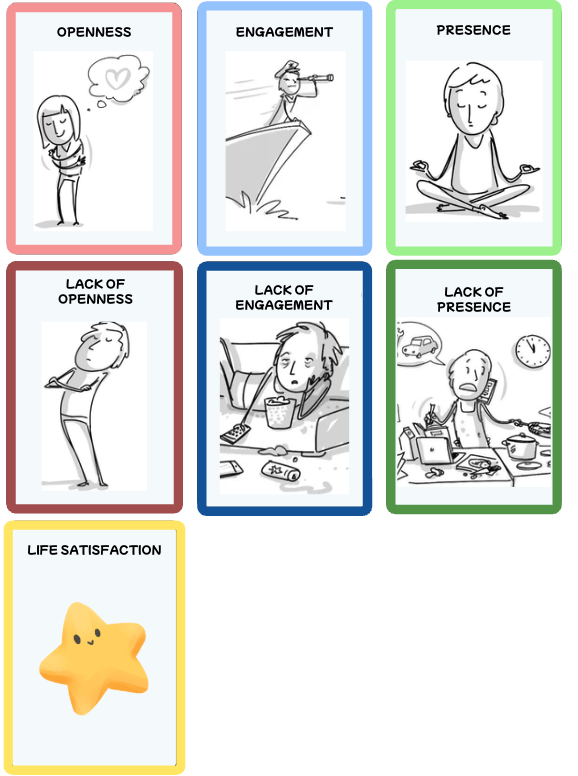
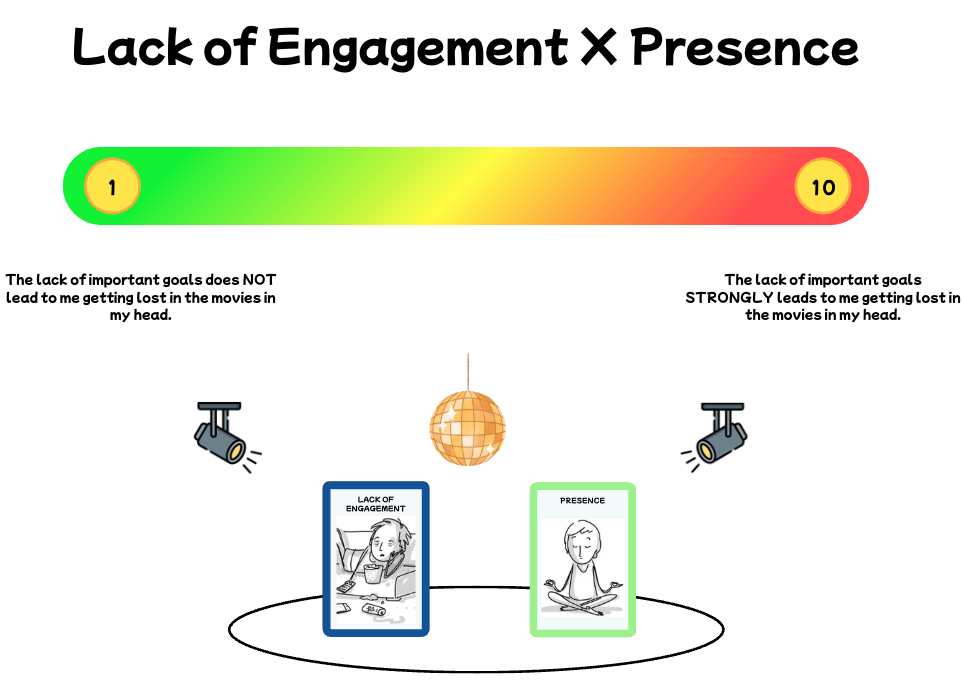
“Dance floor”
An example of an interview with a fictive patient (Marie) can be found in this video: https://www.youtube.com/watch?v=RvC3WEW9BRM (with english subtitles; role play; version alpha)
Outline of session 0
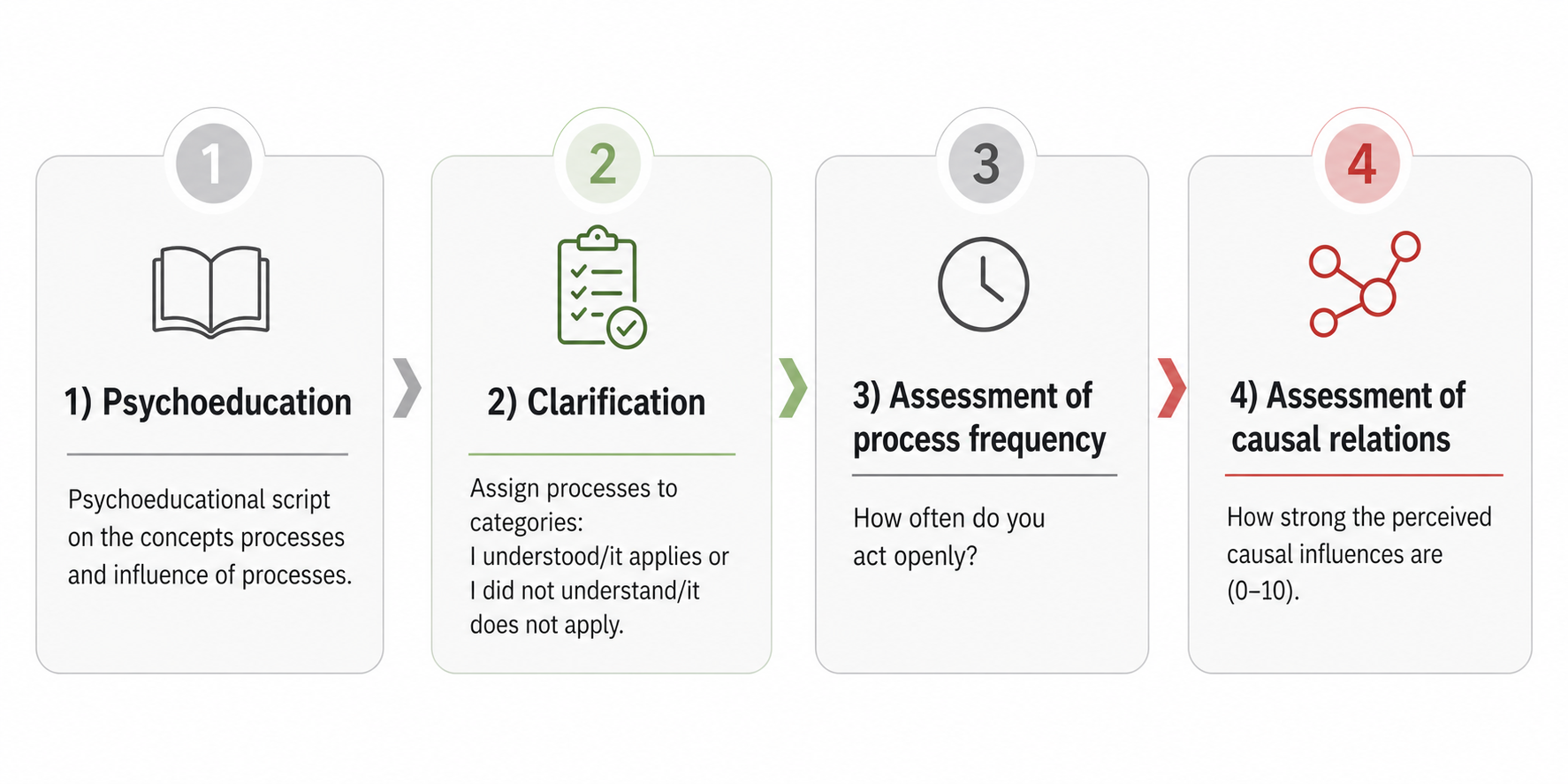
1. psychoeducation
Here I want to explain to adolescents what the triflex processes are
2. clarification of processes
Discuss every card to check what the patients understand under the processes after the psychoeducation. Try to explore at least an example for every process.
3 frequency evaluation
Each node is rated by frequency from 0 to 10. “How often do you feel open or behave with openness?“›
4. causal nodes evaluation
Rate how sure participants are sure that a lack of openness affects engagement (0-10)
5. Evaluation and visualization
Evaluation can be assessed through centrality measures and feedback loops. Visualization can be assured with the R-Package PECAN2
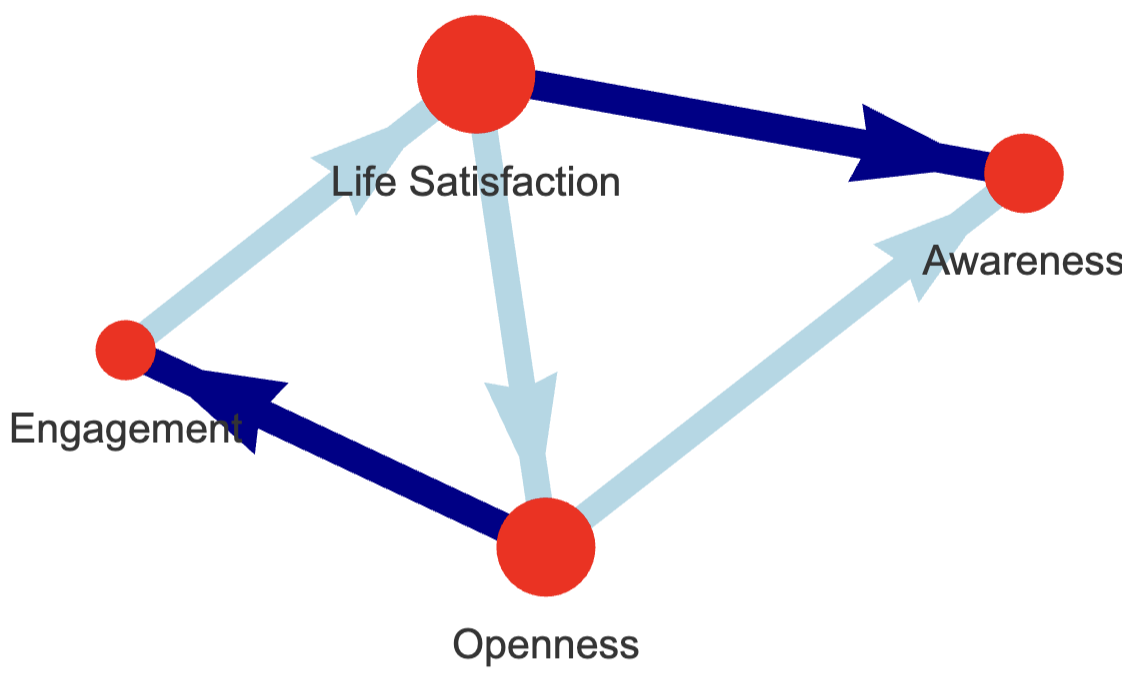
Perceived Causal Network of Marie (Video):
- The size of the nodes (red) describes the frequency of behavior (Engagement is tinier, as Marie feels disoriented and doesn’t know what’s important in her life)
- The color of the edges describes the perceived certainty (Lack of Openness strongly influences awareness)
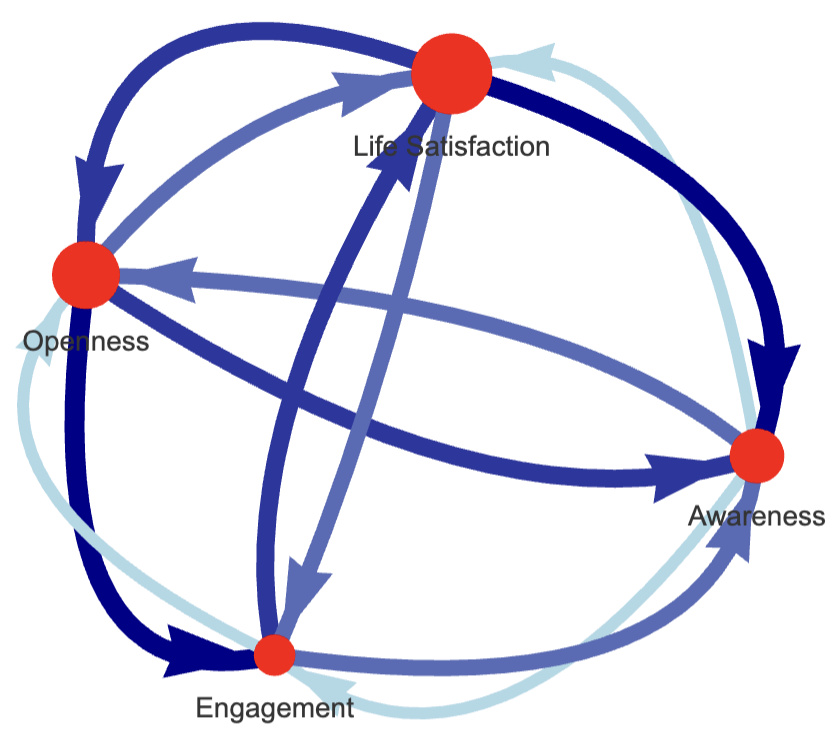
Simplified Perceived Causal Network of Marie (Video)
| Node | Out-degree Cen. | In-Degree Cen. | Rel. Out-Impact | Rel. Vulnerability |
|---|---|---|---|---|
| Awareness | 20 | 27 | 0.206 | 0.278 |
| Engagement | 23 | 24 | 0.237 | 0.247 |
| Life Satisfaction | 27 | 23 | 0.278 | 0.237 |
| Openness | 27 | 23 | 0.278 | 0.237 |
- Out-degree Centrality: how much a node drives the network
- In-degree Centrality: how much a node is driven by the network
- Relative Out-Impact: How much a node (Openness) accounts for the total energy of the network (27.8%)
- Relative Vulnerability: How much a node absorbs the energy of the network
Out-degree Centrality determines the process to start with in therapy since if the node that drives the network the most gets treated, the whole network gets disturbed the most.
The Most Central Node Intervention (MCNI) of Marie would be Openness, whereas the Least Central Node Intervention (LCNI) of Marie would be Awareness.
In the SCED, there will be a baseline, than a MCNI Phase and a LCNI Phase. The order of MCNI and LCNI will be randomized in order to assess if individuals starting with MCNI have a faster progression in psychological flexibility.
Session 1-8
ACT protocol with 12 sessions. 4 sessions/triflex process.
ACT protocol PECAN-CA